 By admin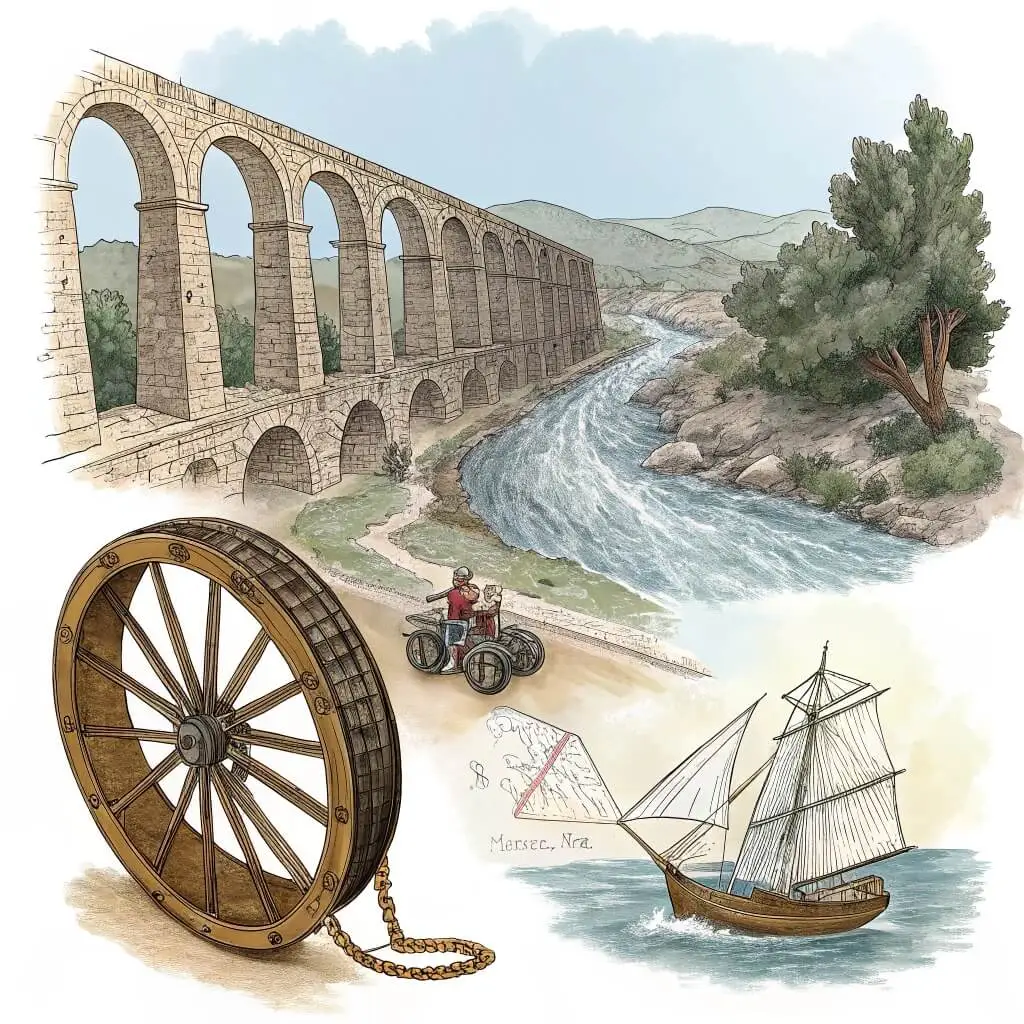
Throughout history, civilizations have thrived not merely because of conquest or wealth but because of their ability to innovate. From the earliest cities of Mesopotamia to the intellectual bastions of Ancient Greece, human societies have continuously crafted tools, systems, and philosophies that laid the groundwork for modern civilization. While we often credit the modern age with technological advancement, many core ideas and inventions that shape our lives today have ancient origins.
This article explores some of the most impactful ancient innovations that continue to influence the world in profound ways—from architecture and medicine to governance and philosophy.
1. The Wheel – The Engine of Progress
The invention of the wheel, dating back to around 3500 BCE in Mesopotamia, is arguably one of the most transformative human innovations. Initially used for pottery making, the wheel’s application expanded rapidly to carts and chariots, revolutionizing transportation and trade.
Modern Relevance:
Today, wheels are integral to everything from cars and airplanes to manufacturing equipment and even digital technologies like hard drives. The conceptual framework behind rotational motion is also foundational in engineering and physics.
2. Written Language – Preserving Human Thought
The Sumerians are credited with creating one of the earliest writing systems, cuneiform, around 3200 BCE. Similarly, Egyptian hieroglyphics and Chinese oracle bone script emerged as complex systems to record events, trade, laws, and beliefs.
Modern Relevance:
Written language is the backbone of modern civilization—used in law, education, communication, and technology. Every contract signed, book read, or email sent traces its lineage back to these ancient scripts.
3. Mathematics – The Universal Language
Ancient Egyptians and Babylonians developed systems of mathematics to address practical needs like surveying land, building structures, and conducting trade. The Greeks, especially figures like Euclid and Pythagoras, formalized mathematical principles that remain foundational today.
Modern Relevance:
Geometry, algebra, and arithmetic are essential not only in academics but also in fields like computer science, engineering, economics, and artificial intelligence. The Pythagorean theorem, for instance, is still taught worldwide and applied in architecture and coding.
4. Democracy – The Power of the People
Ancient Athens is widely regarded as the birthplace of democracy around the 5th century BCE. Citizens had the right to vote and debate public issues, setting a precedent for participatory governance.
Modern Relevance:
While modern democracies are more inclusive and complex, the core idea of rule by the people remains the same. Institutions like parliaments, public forums, and electoral systems find their ideological roots in Athenian practices.
5. Urban Planning – Building Civilized Spaces
The Indus Valley Civilization, particularly the city of Mohenjo-Daro (circa 2500 BCE), showcased advanced urban planning with grid-like streets, drainage systems, and public baths. Likewise, Roman and Chinese cities incorporated aqueducts, roads, and zoning for efficiency and hygiene.
Modern Relevance:
Today’s urban planners still rely on principles established by ancient cities—zoning, infrastructure management, and sanitation. The concept of a structured, livable city is a legacy of ancient urban innovation.
6. Philosophy – The Pursuit of Knowledge
Ancient thinkers such as Plato, Confucius, Laozi, and Buddha examined human nature, ethics, politics, and metaphysics. Their works laid the foundation for religious, moral, and intellectual traditions around the globe.
Modern Relevance:
The philosophical questions raised by these thinkers—What is justice? What is the good life?—remain central to contemporary debates in ethics, law, and governance. Universities today still teach these ancient philosophies as essential components of the humanities.
7. Timekeeping – Mastering the Flow of Time
The Babylonians and Egyptians developed early calendars and sundials to mark time, crucial for agriculture and religious observance. The concept of dividing the day into 24 hours comes from ancient Egyptian astronomy.
Modern Relevance:
Our clocks, calendars, and scheduling systems are built on ancient frameworks. Even the seven-day week has Babylonian roots, tied to lunar cycles and planetary gods.
8. Architecture and Engineering – Monumental Legacies
The Romans, Greeks, and Egyptians left behind architectural marvels—pyramids, aqueducts, amphitheaters, and temples. Roman concrete (opus caementicium) enabled durable construction, while Greek columns set stylistic standards still used today.
Modern Relevance:
Modern buildings incorporate many ancient techniques: arches, domes, columns, and urban layouts. Engineering marvels like the Hoover Dam or modern stadiums owe much to Roman engineering concepts.
Conclusion
Ancient innovations were not primitive stabs in the dark but deliberate, ingenious responses to human needs. The legacy of these early advancements underscores a vital truth: civilization is cumulative. We stand on the shoulders of giants—engineers, philosophers, architects, and scientists—whose insights still guide our paths.
As we rush forward into the age of AI, space travel, and quantum computing, it’s worth remembering that many of the tools, concepts, and systems we use today were crafted thousands of years ago. Understanding these ancient contributions doesn’t just enrich our knowledge of history—it empowers us to innovate more wisely, responsibly, and sustainably in the future.